
We-representations and joint action
When two people act together toward a shared goal, something remarkable happens in the brain: it doesn't just track "what I'm doing" and "what you're doing" separately. Research suggests it builds a combined representation of the joint action — a kind of "we-representation" that captures features of the collaboration as a whole. In a series of studies, we investigated where these representations come from, how they influence performance, and what happens when two people jointly control a single robotic body.
STUDY 1 & 2: EVIDENCE FROM BRAIN SIGNALS DURING JOINT ACTION PLANNING
In two EEG studies, pairs of participants planned and performed joint actions together. We found that even before the action began, neural signals already reflected the structure of the joint action — not just each person's individual contribution. Participants also distributed their attention to their partner's upcoming movements in a way that tracked the demands of the shared task.
Kourtis, D., Knoblich, G., Woźniak, M. & Sebanz, N. (2014). "Attention Allocation and Task Representation during Joint Action Planning". Journal of Cognitive Neuroscience, 26(10), 2275–2286.
Kourtis, D., Woźniak, M., Sebanz, N. & Knoblich, G. (2019). "Evidence for We-representations during joint action planning". Neuropsychologia, 131, 73–83.
STUDY 3: WHAT HAPPENS WHEN TWO PEOPLE CONTROL ONE ROBOT?
We built a setup where two participants simultaneously teleoperate a single humanoid robot — each controlling one of the robot's arms. Before each movement, they could receive "we-information": a cue telling them whether their upcoming arm movements would be the same or different from their co-operator's.
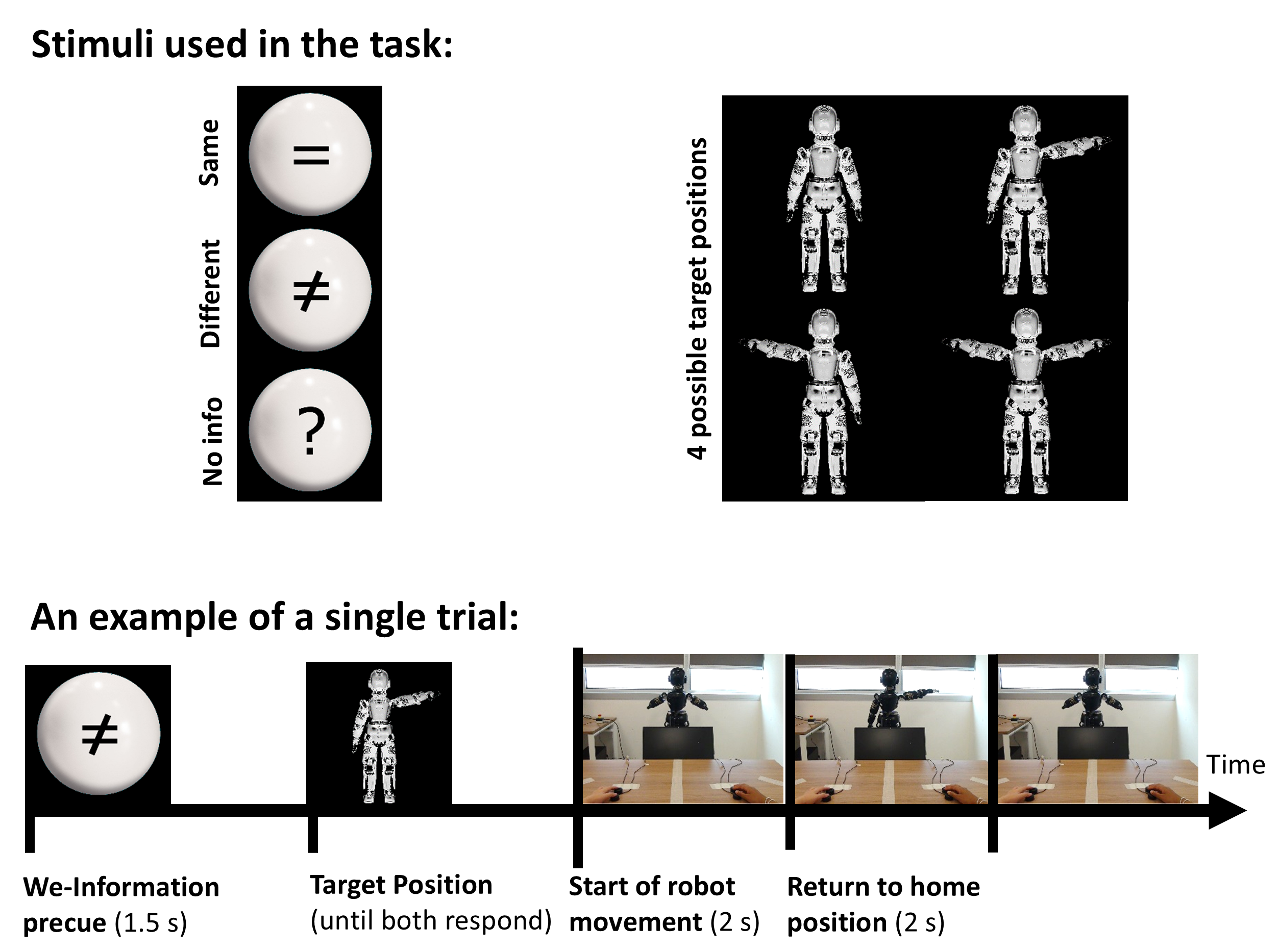
We-information sped up task performance — especially for simpler movement configurations. And after just a brief session of jointly controlling a single robot body, participants reported a striking blurring of boundaries: they felt less able to distinguish between themselves, the robot, and their co-operator.
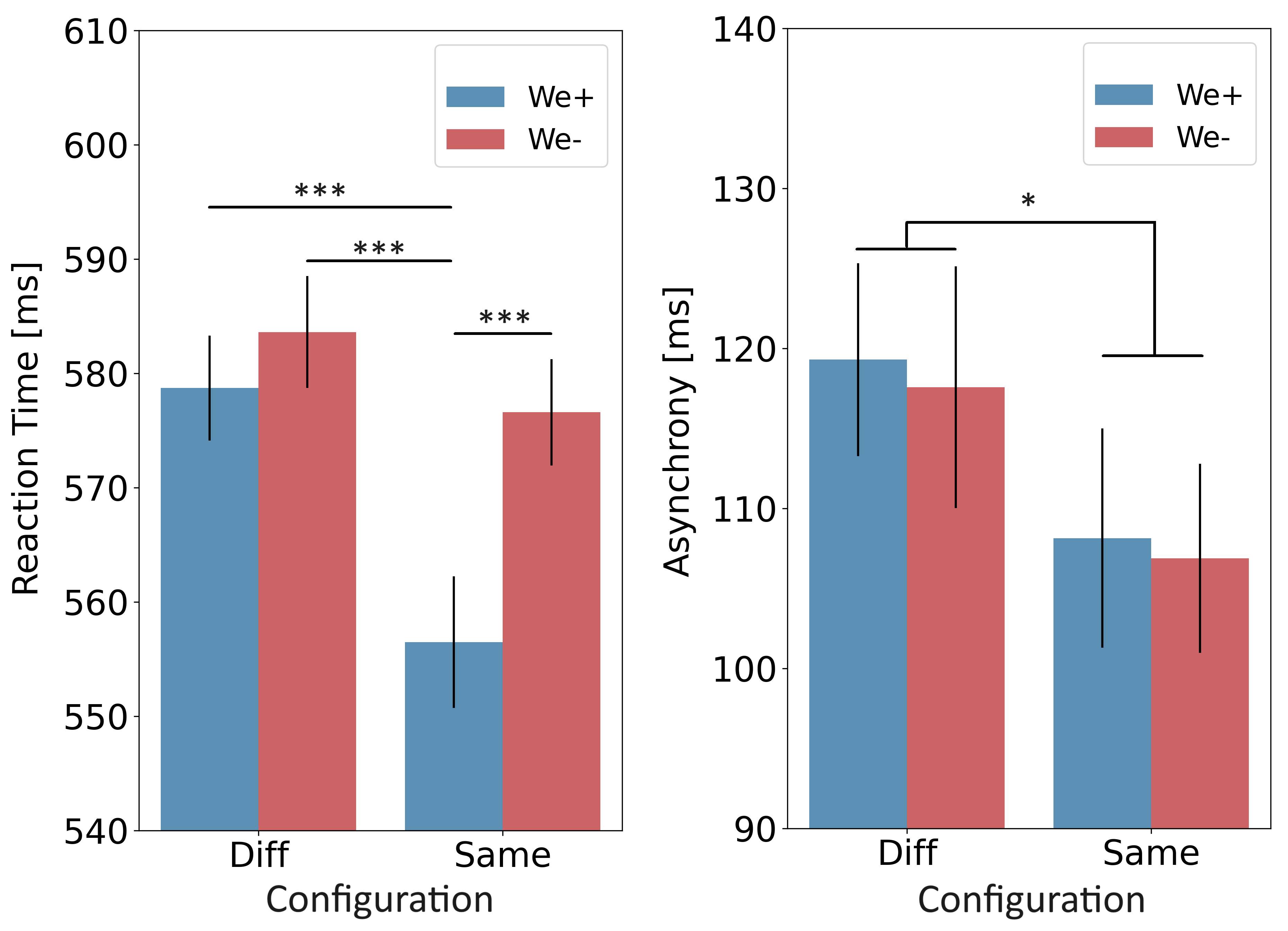
Woźniak, M., Ari, I., De Tommaso, D. & Wykowska, A. (2025). "We-information can facilitate performance in joint teleoperation over a humanoid robot". 34th IEEE International Conference on Robot and Human Interactive Communication (RO-MAN).
STUDY 4: HOW DOES THE BRAIN PROCESS WE-INFORMATION?
In an ongoing EEG study using the same joint teleoperation setup, we are recording brain activity to understand the neural basis of we-information processing. Preliminary results suggest that the mere appearance of the we-information cue modulates early visual brain responses — meaning the brain starts preparing for joint action very rapidly, before conscious deliberation. A full report will be added when the paper is complete.
Woźniak, M., et al. "Two Minds, One Body: Neural correlates of processing of we-information during shared control over a humanoid robot" — work in progress.