Robot autonomy in human-robot interaction
When a robot stops following our commands and starts making its own decisions, how does that change the way we feel about it — and about ourselves? Robots are becoming more and more autonomous, shifting from passive tools we control to active partners we interact with. In a series of studies, we investigated what happens psychologically when the robot takes the wheel.
HOW MUCH DO YOU TRUST A ROBOT THAT ACTS ON ITS OWN?
We showed participants a game in which they played alongside four different robot partners — ranging from one that always did exactly what the player wanted, to one that acted fully on its own using AI. In between were robots that sometimes used their intelligence to pick a better option or achieve the same outcome in a different way.
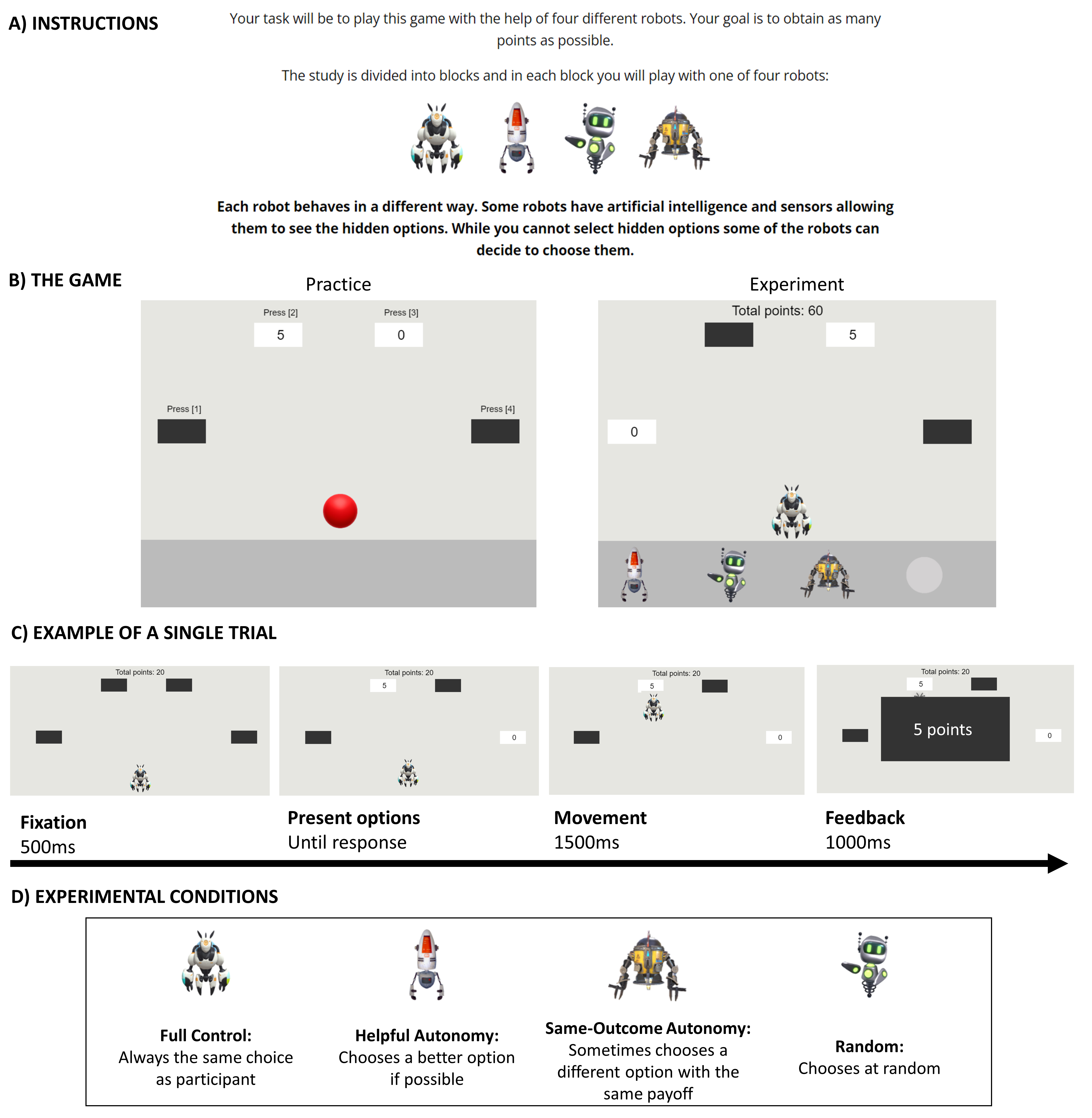
As expected, the more the robot acted independently, the less participants felt in control. But the effect on trust was more surprising: trust did not simply drop as autonomy increased. Instead, it depended on what the robot did with its autonomy — whether it used it to help or to act unpredictably.
Woźniak, M., De Tommaso, D., Knoblich, G., Wykowska, A. (accepted, International Journal of Social Robotics). "The influence of robot autonomy on sense of agency and trust towards a robot"
DOES AUTONOMY MAKE YOU BETTER OR WORSE AT THE TASK?
In a follow-up study, we had participants teleoperate a real humanoid robot — controlling its movements to complete physical tasks — while the robot offered different levels of autonomous assistance. We tracked both how well they actually performed, and how in control they felt.
Autonomy helped with efficiency, but at a cost: the more the robot did on its own, the less operators felt responsible for the outcome. This has real implications for designing robots for high-stakes environments where accountability matters.
Woźniak, M., Ari, I., De Tommaso, D., Wykowska, A. (2024). "The influence of autonomy of a teleoperated robot on user's objective and subjective performance". 33rd IEEE RO-MAN.
DOES THE ROBOT'S MOTIVE MATTER FOR HOW OUR BRAIN RESPONDS?
When a robot acts on its own, we can't help asking: why is it doing that? Is it trying to help, is it acting against us, or is it simply broken? In an ongoing EEG study, we record brain activity while participants watch a robot behave in one of these three ways. Preliminary results suggest that the brain responds very differently depending on the robot's apparent intention — even at early stages of processing, well before conscious deliberation kicks in. A full report will be added when the paper is complete.
Woźniak, M., et al. "The Good, the Bad and the Broken: How Robot's Motives Affect Neural Processing of Robot's Autonomous Behavior" — work in progress.